The Hard Truth
80 grams of protein a day is where most men over 40 actually are — and it's not enough to preserve muscle mass. It's not a bad diet. It's not an unhealthy lifestyle. It just doesn't meet the threshold your body needs after 40 to hold on to the muscle you've spent decades building.
Here's what 80 grams of protein looks like in a day — and more importantly, here's what it's doing to your muscle while you eat it.
This post isn't about shaming a number. It's about making the gap visible. Most men eating 80g per day have no idea they're short. The meals look reasonable. Nothing feels wrong. That's exactly the problem — the deficit is silent until the consequences aren't.
Your muscle disagrees.
What a Typical 80g Day Actually Looks Like
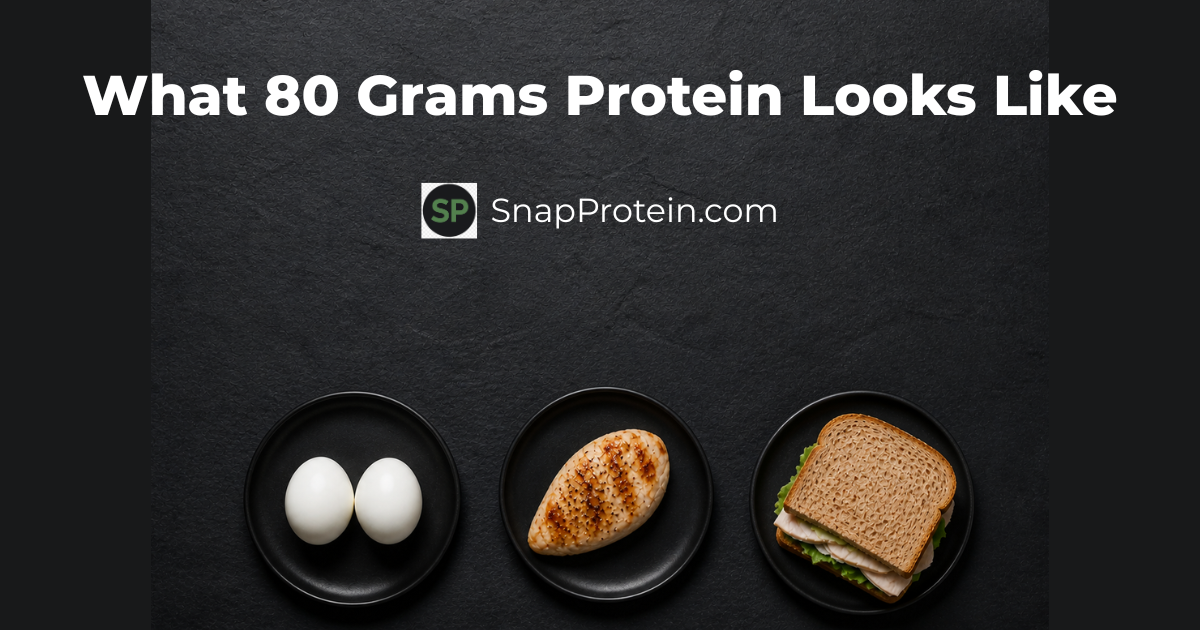
This is a real day. Nothing unhealthy. Nothing extreme. Just the kind of eating pattern that adds up to 80g without anyone realizing it.
That day has vegetables. Lean protein. Whole grains. A piece of fruit. By most people's definition of "eating well," that's a solid day. But for a man over 40, it's 40 to 50 grams short of what the research says is needed to preserve muscle mass.
How 80g Compares to What You Actually Need
Here's where American men get confused — and it's not their fault. The official government recommendation (the RDA) for protein is 0.8 grams per kilogram of bodyweight — that's roughly 0.36 grams per pound. For a 180-pound man, that comes out to about 65 grams per day.
So at 80 grams, you're actually above the government recommendation. That feels fine. That feels adequate. The problem is the RDA was set in 1985 to prevent protein deficiency in healthy young adults. It was never designed to preserve muscle mass in aging men.
What the Research Actually Says About Protein After 40
The science on this is consistent across dozens of studies. Men over 40 need significantly more protein than the RDA suggests — not because the RDA is wrong for young adults, but because aging changes how efficiently your body uses dietary protein.
Here's what research-backed guidelines actually look like, in both kilograms and pounds so there's no confusion:
| Goal | Per kg of bodyweight | Per lb of bodyweight | For a 180 lb man |
|---|---|---|---|
| Government RDA (deficiency prevention) | 0.8g/kg | 0.36g/lb | ~65g |
| Minimum for muscle preservation after 40 | 1.2g/kg | 0.55g/lb | ~100g |
| Optimal for muscle maintenance after 40 | 1.4g/kg | 0.64g/lb | ~115g |
| Active recomposition target | 1.6g/kg | 0.73g/lb | ~130g |
At 80 grams per day, a 180-pound man is eating at 0.98g/kg (0.44g/lb) — well above the RDA, but well below the minimum threshold for muscle preservation that research actually supports for men over 40.
What Happens to Your Muscle at 80g Per Day
After 40, a condition called anabolic resistance sets in. Your muscles become less efficient at using dietary protein to build and repair tissue. A younger man might need 20g of protein at a meal to trigger a meaningful muscle protein synthesis response. After 40, that threshold rises — you need more protein per meal, and more total protein per day, just to achieve the same maintenance effect.
At 80g per day — spread across 3–4 meals — most men over 40 are not clearing this threshold consistently. The result is a gradual, silent acceleration of sarcopenia: the age-related loss of muscle mass and strength that affects every man after 30, and accelerates sharply after 50 if protein intake stays low.
The sarcopenia math: Men lose an average of 3–8% of muscle mass per decade after 30 under normal conditions. Research shows that men with chronically low protein intake — below the 1.2g/kg (0.55g/lb) threshold — experience significantly faster rates of muscle loss. That's not a small difference. Over a decade, the gap between 80g and 120g of daily protein could mean the difference between staying strong and struggling with basic physical tasks in your 60s and 70s.
The frustrating part: none of this is visible day to day. You don't feel muscle leaving. The scale might not even move. The process is slow and cumulative — which is exactly why most men don't connect their protein intake to how they feel and perform 10 years later.
Where 80g Sits in the Full Range
The First Move: Getting From 80g to 100g
The good news: getting from 80g to 100g doesn't require a diet overhaul. It requires identifying where the gaps are and making two or three targeted swaps.
| Simple Swap | From | To | Protein Gain |
|---|---|---|---|
| Breakfast | 2 eggs | 3 eggs + Greek yogurt | +21g |
| Lunch protein | 3 oz turkey | 5 oz chicken breast | +14g |
| Dinner portion | 4 oz chicken | 6 oz chicken or beef | +12g |
| Afternoon snack | Nuts + fruit | Cottage cheese (1 cup) | +19g |
Any two of those swaps gets you from 80g to 100g. From there, see what 100 grams of protein looks like for the next step — and what 120 grams of protein looks like for the full muscle preservation baseline.
You don't need to get to 120g tomorrow. Getting from 80g to 100g consistently is the first meaningful milestone — and it's already a significant improvement over where most untracked men are. Build the habit at 100g first. The number climbs from there.