Protein Targets · Men Over 40

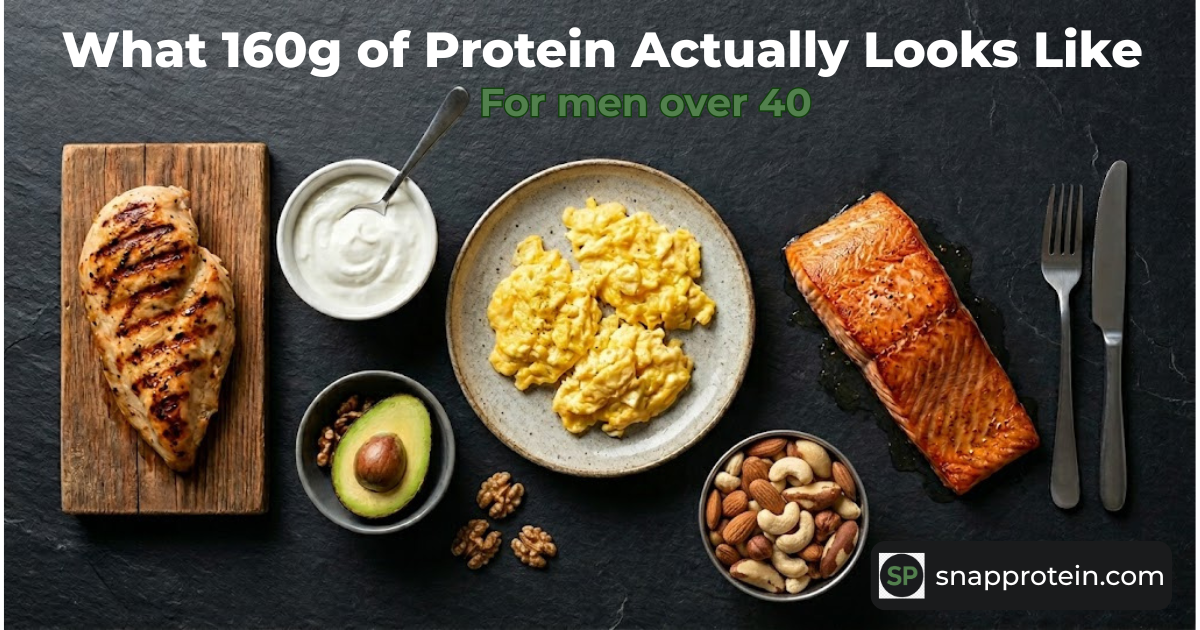
What 160g of Protein Actually Looks Like
for Men Over 40

120g protects your muscle. 160g rebuilds it. Here's exactly what a 160g day looks like in real meals — no extreme eating required.

By Robert · May 2026 · 6 min read

What 160g of protein looks like for men over 40

The Short Answer

A 160g protein day looks like: 3 eggs + Greek yogurt at breakfast (40g), a large chicken breast at lunch (50g), a protein shake mid-afternoon (25g), and ground beef or salmon at dinner (45g). One solid protein anchor at every meal — no extreme portions, no skipping.

160g
daily protein for active muscle recomposition
40g
average per meal across 4 eating occasions
+40g
above the 120g baseline — roughly one extra serving

If you've already seen what a 120g protein day looks like, you know the baseline. Three meals anchored by real protein sources gets most men close. 120g is the number that stops muscle loss in its tracks after 40.

But 160g is a different goal. This is for men who aren't just trying to preserve what they have — they're actively trying to rebuild. Lose the gut. Add lean mass back. The difference between 120g and 160g is roughly one extra serving of protein per day. But knowing that in theory and seeing it on a plate are two different things.

120g protects your muscle.
160g rebuilds it.

The Two Targets: What Each One Is Actually For

Baseline Target
120g
Muscle Preservation
The maintenance floor for most men over 40. Prevents the gradual muscle loss that starts in your 40s and accelerates through your 50s.
Recomposition Target
160g
Muscle Rebuilding
The active target for men pursuing lean mass gain while reducing body fat. Requires one additional high-protein serving per day above the baseline.

A note on body weight: These targets are general for men in the 160–190 pound range. The underlying principle — roughly 0.8–1g per pound of bodyweight — scales with you. A 200-pound man pushing for recomposition is looking at 170–200g daily.

What 160g of Protein Looks Like: A Full Day

Here's a complete sample day built around foods most men over 40 already eat. No exotic proteins, no meal prep marathons. Just consistent high-protein choices across four eating occasions.

Breakfast
Eggs + Greek Yogurt
3 whole eggs · 1 cup plain Greek yogurt · Optional: 1 slice turkey bacon
42
grams
Lunch
Large Chicken Breast
8 oz grilled chicken breast · Side salad or roasted vegetables
52
grams
Afternoon
Protein Shake
1–2 scoops whey or casein · Water or milk
25
grams
Dinner
Ground Beef or Salmon
6 oz 90% lean ground beef or 6 oz salmon · Roasted potatoes or rice · Vegetables
44
grams
Daily Total
4 Meals · Real Food · No Extreme Eating
Breakfast + Lunch + Afternoon Shake + Dinner
163
grams

The Best Foods for Hitting 160g Consistently

Getting to 160g consistently depends on knowing the protein density of your go-to foods. These are the workhorses — high protein relative to calories, widely available, already in most men's rotation.

Food Serving Protein
Chicken breast, grilled6 oz38g
Greek yogurt, plain1 cup20g
Eggs, whole3 large18g
Ground beef, 90% lean6 oz40g
Salmon, cooked6 oz38g
Cottage cheese, low-fat1 cup25g
Whey protein shake1 scoop25g
Tuna, canned in water5 oz can30g
Turkey breast, deli sliced4 oz22g
Fairlife milk1 cup13g

Can You Hit 160g Without Protein Supplements?

Technically yes — but it's tight. A full day of whole food sources can get you there if every meal is built around a serious protein anchor. The problem is meal size. To hit 160g from food alone, you're eating large portions at every sitting, which can feel like a second job when you're not hungry.

One protein shake per day makes 160g consistently achievable without forcing food. It adds 25g without adding much volume or effort — and for most men, that's the difference between hitting the number most days versus barely clearing it on good days.

Why Tracking Matters More at 160g Than at 120g

At 120g, experienced eaters can often get close by feel. Three solid protein meals and you're in range. The margin for error is forgiving.

At 160g, feel doesn't work as well. You need to know your running total by mid-day. If you're sitting at 60g by 2pm, dinner needs to be a serious protein meal. If you're at 90g, you have more flexibility. That mid-day check-in is the difference between hitting your number and falling 30–40g short without realizing it.

This is where a simple tracking habit earns its keep. Not a full macro app with calories and carbs — just your protein number, updated once or twice a day, so you always know where you stand.

R
A note from Robert: I spent a long time eating what felt like a lot of protein and wondering why I wasn't seeing the results I expected. The problem wasn't the food — it was that I had no idea what my actual number was at the end of the day. Some days I'd realize at 9pm I'd barely hit 90g. You can't manage what you can't see. Once I started tracking just protein — nothing else, just that one number — the pattern became obvious, and the results followed.

Continue Reading

Frequently Asked Questions

What does 160g of protein a day look like in real food?
A typical 160g day: 3 eggs + Greek yogurt at breakfast (40g), a large chicken breast at lunch (50g), a protein shake mid-afternoon (25g), and ground beef or salmon at dinner (45g). Consistent high-protein choices at every meal — no extreme eating required.
Is 160g of protein a day too much for men over 40?
For most active men over 40 pursuing muscle recomposition, 160g is within the safe and effective range. Research supports 0.7–1g per pound of bodyweight. For a 160–180 pound man training consistently, 160g is a reasonable target, not an extreme one.
What is the difference between a 120g and 160g protein day?
120g is the muscle preservation baseline — enough to prevent significant muscle loss after 40. 160g is the recomposition target — enough to actively support muscle growth while in a modest caloric deficit. In practical terms, the difference is roughly one additional high-protein serving per day.
How can men over 40 eat 160g of protein without supplements?
It's possible but tight. Large portions of chicken, beef, eggs, fish, Greek yogurt, and cottage cheese can get you there — but one protein shake per day makes 160g far more consistently achievable without overeating at every meal.
Should I track my protein if I'm trying to hit 160g a day?
Yes — at 160g, tracking matters more than at 120g because the margin for error is smaller. You don't need a full macro app — just your protein number, checked once or twice per day, so you know whether dinner needs to be heavy or light on protein.

Know your number by mid-day.
Every day.

Track only protein. See your running total in seconds. Built for men over 40 who want results, not a spreadsheet.

Try SnapProtein Free →