Quick Answer
- Extended soreness (3+ days) after moderate exercise is usually a protein problem, not an age problem.
- Muscle repair requires amino acids from dietary protein — when intake is low, repair slows and inflammation lingers.
- After 40, anabolic resistance means your repair signal is already weaker — inadequate protein compounds the problem significantly.
- 30–40g of protein within 1–2 hours post-workout directly accelerates recovery by supplying amino acids when demand is highest.
- Men who consistently hit 1.2g/kg of protein daily typically see noticeable improvement in recovery within 2–4 weeks.
The Real Reason You're Still Sore on Day Three
Here's what most men are told: "You're sore because you're getting older. Recovery just takes longer after 40. That's normal." And they accept it — because it feels true, and because nobody has offered them a better explanation.
Here's what's actually happening: exercise creates microscopic tears in muscle fibers. That's not damage to be avoided — it's the stimulus that drives adaptation and growth. The soreness you feel is the inflammatory response that follows, as your body dispatches repair resources to the damaged tissue. Under normal circumstances in a younger, well-fueled body, this process resolves in 24–48 hours.
After 40, two things change. First, anabolic resistance means your muscles' repair machinery responds less efficiently to the signal to rebuild. Second — and this is the part most men never hear — if you're not eating enough protein, your body literally doesn't have the raw materials to complete the repair job on schedule. The construction crew shows up but there's no lumber. The job drags on.
That 72–96 hour soreness that feels like aging? For most men, it's a protein deficit wearing an age costume.
The Biology of DOMS — What's Actually Happening
Delayed onset muscle soreness — DOMS — develops 12–48 hours after exercise because the inflammatory repair process takes time to get underway. The peak discomfort typically arrives 24–72 hours post-workout, not immediately after, which is why you often feel fine leaving the gym and wake up stiff the next morning.
The Repair Process — Step by Step
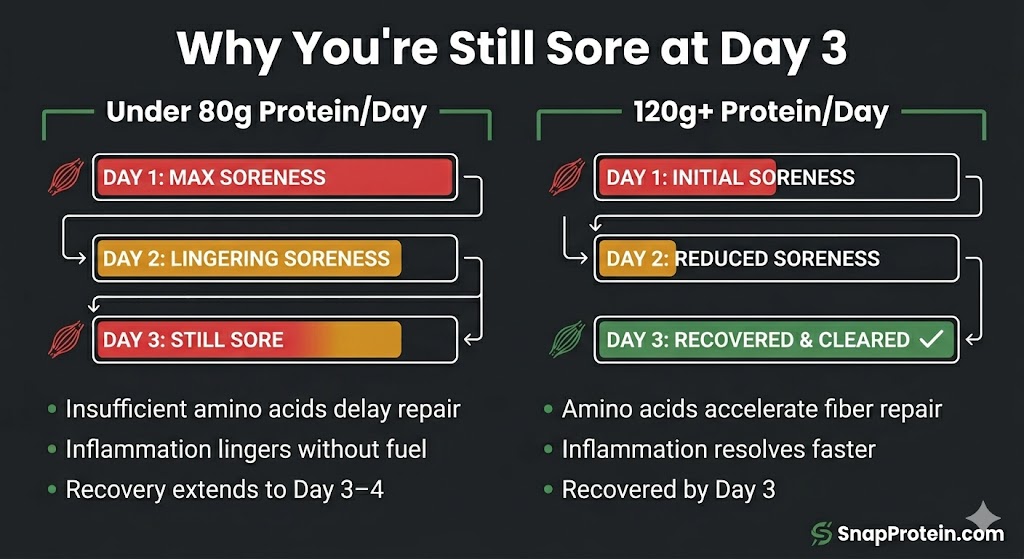
What Recovery Actually Looks Like — With and Without Protein
❌ Under 80g Protein/Day
Typical intake for most men over 40
✓ 120g+ Protein/Day
Research-backed target for men over 40
Same workout. Same man. The difference is whether the repair crew had materials to work with. Day 1 soreness is identical — the damage was the same. But by Day 3, the well-fueled version has largely resolved while the protein-deficient version is still grinding through the inflammation phase.
Why This Hits Harder After 40
Anabolic resistance — the age-related decline in your muscles' sensitivity to protein signals — is the multiplier that makes protein deficiency so costly after 40. At 28, your muscles respond to a moderate protein intake with a robust repair response. At 48, the same protein intake triggers a significantly weaker signal.
This means two things for recovery:
- You need more total daily protein to generate the same repair response — research supports 1.2–1.6g per kilogram of bodyweight, compared to 0.8g/kg for younger adults.
- Per-meal dosing matters more — your muscles need at least 30–40g of protein per meal to cross the leucine threshold that triggers muscle protein synthesis. A 15g lunch doesn't contribute meaningfully to repair, regardless of your daily total.
The protein pacing research is directly relevant here: men who distribute protein across 3–4 meals of 30g+ recover measurably faster than men who eat the same total unevenly. The repair machinery needs consistent amino acid availability throughout the day — not one large hit at dinner.
When you're sore for 3+ days, you typically reduce workout frequency or intensity — which reduces the training stimulus that drives adaptation — which makes you more susceptible to soreness next time you train. The protein deficit creates a recovery cycle that makes training feel harder and less productive, reinforcing the false belief that your body "just can't handle it anymore." Fixing protein breaks the cycle.
The Post-Workout Window — When Protein Matters Most
Exercise dramatically increases muscle protein synthesis rates for 1–2 hours post-workout. During this window, your muscles are primed to absorb and use amino acids for repair at a significantly higher rate than at rest. Research from Dr. Stuart Phillips at McMaster University and others consistently shows that consuming 30–40g of protein within this window accelerates recovery and reduces the duration of DOMS.
This isn't about taking a specific supplement. It's about having a protein-anchored meal or snack within two hours of finishing your workout. Greek yogurt and eggs. A chicken breast. Cottage cheese with a protein source alongside it. The source matters less than hitting the threshold.
The post-workout meal is not optional for men over 40. At younger ages, the repair response is robust enough that timing matters less. After 40, anabolic resistance means the window is narrower and the dose requirement is higher. Missing the post-workout window on a regular basis is one of the primary reasons men over 40 feel like training "doesn't work" the way it used to. See how to build a 40–50g meal that covers this window effectively.
The 3-Part Recovery Protocol
Hit Your Daily Target — Every Day
Recovery happens over 24–48 hours, not just in the meal after a workout. Your muscles need amino acid availability throughout the full repair window. Consistently hitting 1.2g/kg daily is more important than any single meal timing strategy. Use the protein calculator to find your exact number.
30–40g Within 2 Hours Post-Workout
Don't let the post-workout window close without a threshold-clearing protein dose. Greek yogurt, eggs, cottage cheese, a whey shake — anything that hits 30g+ within two hours of finishing. This is the single highest-leverage timing move for recovery.
Casein Before Bed on Training Days
Muscle repair continues overnight while you fast. Cottage cheese (25g of slow-digesting casein protein) before bed on training days provides a steady amino acid supply during the overnight repair window — directly reducing next-morning stiffness. See the casein vs whey breakdown for why this matters.
Why You Can't Fix What You Can't Measure
Here's the pattern I've seen repeatedly: a man trains consistently, eats "pretty well," and accepts lingering soreness as the price of being over 40. He's not dramatically under-eating protein — he's just 40–50g short of his target most days. Not enough to feel obviously wrong. Enough to slow his recovery by a full day or two.
The only way to know whether you're hitting your recovery-supporting protein target is to track it. Not forever — but long enough to calibrate your eating patterns to your number. Most men who start tracking discover within a week exactly where their deficit lives. Usually it's breakfast and the post-workout meal. Fix those two, and the 3-day soreness problem often resolves within a few weeks.
If you're consistently sore for 3+ days after moderate training, the most useful thing you can do before changing your workout, buying supplements, or scaling back your training is to track your protein for 7 days. The data almost always tells you everything you need to know. See whether your current intake is actually enough for your bodyweight.
Continue Reading
- Anabolic Resistance After 40: Why Recovery Changes With Age
- The Protein Pacing Strategy: How to Stay Anabolic All Day
- What 120g of Protein Actually Looks Like
- Whey vs. Casein vs. Collagen — Which Actually Matters After 40?
- How to Get 50g of Protein for Breakfast (Without a Shake)
- Sarcopenia After 40: The Silent Muscle Loss Problem