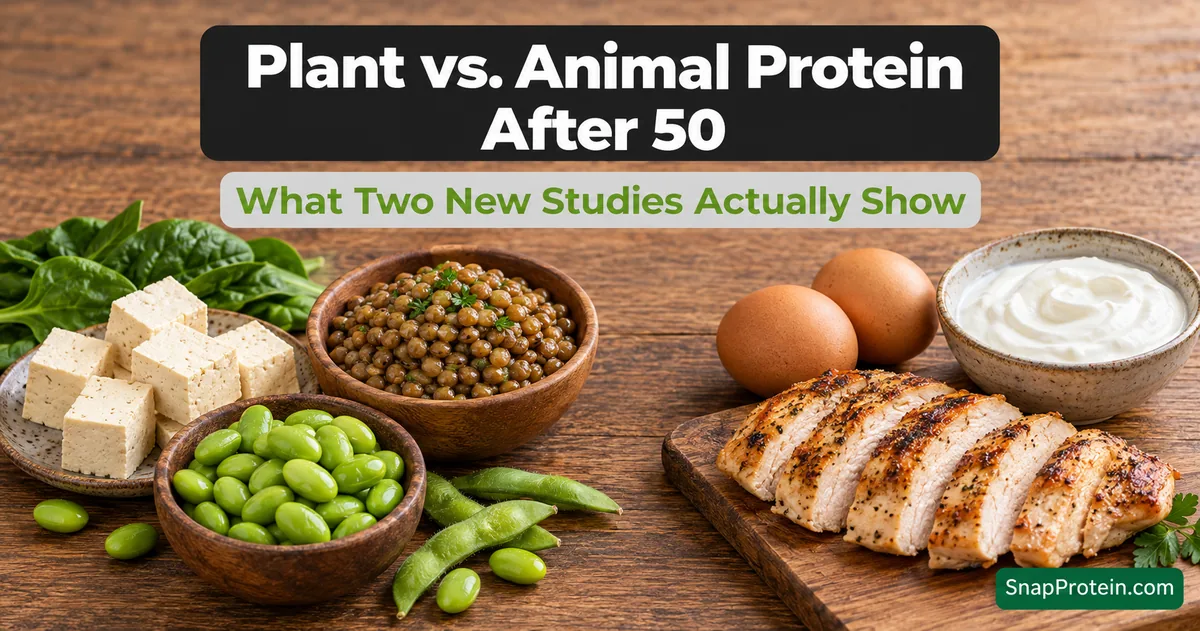
- In a 2026 trial, adults 65+ who switched to a self-selected vegan diet ate about 20–28g less protein a day and lost arm and leg lean mass over 12 weeks. Omnivores held steady.
- In that trial, adding strength training cut the loss roughly in half — but didn't erase it.
- In a second 2026 trial, adults 55+ who lifted three times a week gained lean mass and strength on both vegetarian and omnivorous diets. The vegetarians ate less protein than the meat-eaters, and their average gains were smaller — but that difference wasn't statistically certain.
- Neither trial could separate protein source from how much protein and how many calories people ate.
- The takeaway: if you're shifting toward plants after 50, plan your protein on purpose — and check that you're actually hitting it.
Why This Question Matters After 50
After 50, your muscles respond less to the same amount of protein than they did at 25 — it's called anabolic resistance. At the same time, more men are cutting back on red meat for cholesterol, blood pressure, or general health. Both trends are real. The question is what happens when they collide: can you eat more plants and still hold on to your muscle?
Until recently, most of the research on plant vs. animal protein was done in young adults. In 2026, two randomized trials from the Netherlands finally tested it in people over 55.
Study 1: What Happened When Adults 65+ Went Vegan
Researchers at Wageningen University randomly assigned 72 healthy adults aged 65 and older to one of three groups for 12 weeks: a self-selected vegan diet, their usual omnivorous diet, or a self-selected vegan diet plus resistance exercise.
"Self-selected" means participants chose their own vegan meals. They weren't left on their own — the study included regular nutrition meetings, recipes, guidance on plant swaps, and some provided food. But they didn't get feedback on what they were actually eating while the study ran.
Study 1 by the Numbers
The important caveat: the vegan and omnivorous diets weren't matched for protein or calories, and the vegan groups also lost body weight. So this trial can't tell us whether the muscle loss came from the type of protein, the lower amount of protein, eating fewer calories overall — or a mix of all three. What it does show clearly: switching diets without a protein plan changed what people ate in a way that mattered.
Study 2: The IMPACT Trial — Vegetarians vs. Meat-Eaters, Both Lifting
Researchers at the Amsterdam University of Applied Sciences randomly assigned 108 adults aged 55 and older (median age 66) to a lacto-ovo vegetarian diet (dairy and eggs allowed, no meat or fish) or an omnivorous diet. Both groups did the same supervised strength training three times a week for 12 weeks, and both were coached to eat at least 1.2 grams of protein per kilogram of body weight per day.
IMPACT by the Numbers
One more detail stood out: among the vegetarians, people who ate more protein tended to gain more lean mass. That's an association within one group — not proof that eating more caused the extra gains — but it fits the overall picture.
The Third Study Most Headlines Missed
A 2025 crossover trial from the same Wageningen research group fed active older adults (average age 72) carefully planned vegan and omnivorous diets matched for calories and protein, 10 days each. Daily muscle protein synthesis was not significantly different between the two diets.
That's short-term data on muscle-building rates, not long-term muscle size — but it points the same direction as research in younger men already eating vegan or omnivorous diets: when protein and calories are matched, the differences between plant and animal diets shrink.
What These Studies Show — and What They Don't
| Claim | What the evidence says |
|---|---|
| Switching to a plant-based diet without a protein plan can lower your protein | Supported Study 1 |
| Adults over 55 can build muscle and strength on a vegetarian diet | Supported with strength training (IMPACT) |
| Plant protein is inherently worse for muscle | Not proven source, amount, and calories weren't separated |
| Strength training fully protects you | Partly it helped a lot, but didn't erase the losses in Study 1 |
| Tracking protein prevents muscle loss | Not tested a practical tool, not something these trials studied |
If You Eat Mostly Plants: How to Protect Your Muscle
Eat enough, period. A diet switch can quietly become a calorie cut. Losing weight on purpose is one thing; losing it by accident while your protein drops is how muscle goes with it.
Know your number — and actually reach it. For most men over 50, that's at least 1.2 grams per kilogram of body weight daily, and more if you're lifting. Here's how to find yours. Many plant proteins are less digestible and lower in leucine — the amino acid that flips the muscle-building switch — than animal proteins, so landing right at the minimum leaves less margin for error.
Anchor every meal with protein. Tofu, tempeh, edamame, lentils, beans, and seitan are the heavy hitters. If you eat dairy and eggs, Greek yogurt, cottage cheese, and eggs make the math much easier. A soy or pea protein shake can close a gap. Mixing sources across the day helps, because plant proteins vary in their amino acid makeup. Aim for a solid serving at each meal — here's why per-meal amounts matter more after 40.
Keep lifting. In both trials, strength training made a real difference. It's not optional.
If You Eat Meat: This Still Applies to You
You don't have to go vegan to run into this. Swapping a steak dinner for a grain bowl, or eggs for oatmeal, because it's "healthier" can drop 20–30 grams of protein from your day without you noticing. Plant-forward eating can be a great move for your heart. Just make sure your protein comes along for the ride.
The Real Lesson: Know Your Number
These trials didn't test tracking — that's not what they were designed to do. But here's what struck me: in Study 1, participants' protein dropped by 20-plus grams a day, and the only people who saw that number were the researchers, after the fact.
If you change how you eat, the simplest safeguard is to see your protein number every day while it's happening. Not every calorie. Not every macro. Just the one number that protects your muscle.
Talk to your doctor first if you have kidney disease or another condition that affects how much protein you should eat. This article is for general information, not medical advice.
Sources
- Domić J, et al. A self-selected vegan diet reduces skeletal muscle mass in healthy older adults: a randomized controlled trial. Am J Clin Nutr. 2026. Abstract · Study protocol
- Van Oppenraaij et al. Effects of a self-selected vegetarian vs. omnivorous diet on protein intake and muscle mass in older adults during resistance exercise: the IMPACT randomized controlled trial. Am J Clin Nutr. 2026. PubMed
- Domić J, et al. Vegan vs. omnivorous diets and daily muscle protein synthesis in older adults: a randomized crossover trial. J Nutr. 2025. PubMed
- Hevia-Larraín V, et al. High-protein plant-based diet versus a protein-matched omnivorous diet to support resistance training adaptations. Sports Med. 2021. Springer
- Gorissen SHM, et al. Protein content and amino acid composition of commercially available plant-based protein isolates. Amino Acids. 2018. PMC