The Short Answer
- Real beef liver is the most nutrient-dense option by a significant margin — 23g protein per serving, massive B12, vitamin A, heme iron, zinc, CoQ10, and copper in the most bioavailable forms available
- Liver-only capsules are freeze-dried liver — essentially the same nutrient profile in pill form. Six capsules equal roughly 1/2 to 1 oz of fresh liver. Practical, not equivalent to a full serving
- Multi-organ blends combine liver, heart, kidney, and spleen for broader nutrient coverage — but dilute the liver content. More variety, less concentration of liver's standout nutrients
- None of these are protein sources. A serving of organ capsules delivers 2–3g of protein at most. They support the environment for muscle maintenance — they don't replace hitting your daily protein number
- The honest bottom line: if you'll eat it, real liver once a week beats every capsule on the shelf
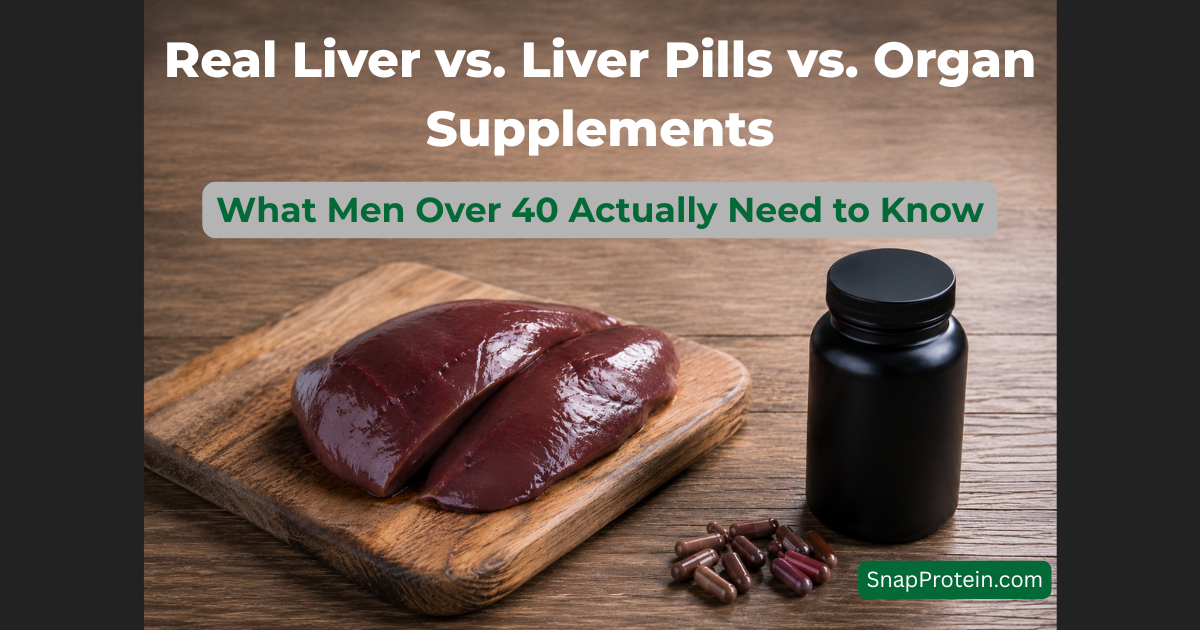
I have a jar of beef organ supplements sitting on my counter right now. I bought it, I've been taking it on and off, and I'll be honest — I wasn't entirely clear on what I was actually getting versus just eating real liver. The marketing on these things is aggressive: grass-fed, ancestral nutrition, nature's multivitamin, whole-food bioavailability. It all sounds compelling.
But when you start asking direct questions — what's actually in this? How does it compare to just eating liver? What's the difference between a liver-only pill and an organ complex? — the answers get murkier fast. So I did the work, looked at the actual numbers, and I'm giving you the honest breakdown.
One thing upfront: I'm not reviewing brands, recommending products, or telling you what to buy. There are plenty of sites doing that. What I want to do is give men over 40 who are focused on muscle maintenance and sarcopenia prevention a clear-eyed look at what these things actually are, what they actually do, and where they fit — or don't — in the bigger picture.
First: Why Liver Keeps Coming Up
Beef liver isn't a supplement trend that started on TikTok. It's one of the most nutritionally dense foods on earth, and it's been prized by virtually every traditional culture that had access to it. Bodybuilders were taking desiccated liver tablets in the 1930s. The research on its nutritional profile is not new, even if the marketing around it is.
Here's what a 3-ounce serving of cooked beef liver actually delivers:
| Nutrient | Amount per 3 oz | % Daily Value | Why It Matters After 40 |
|---|---|---|---|
| Protein | 23g | 46% | Complete amino acid profile — counts toward your daily target |
| Vitamin B12 | 70 mcg | ~2,900% | Energy production, nervous system function, red blood cell formation |
| Vitamin A (retinol) | 4,200 mcg RAE | ~730% | Immune function, cell growth, tissue repair |
| Heme Iron | ~5mg | ~28% | Oxygen delivery to muscle tissue — absorbed at 15–35% vs 2–20% for plant iron |
| Copper | ~12mg | ~1,300% | Energy production, connective tissue repair |
| Zinc | ~4mg | ~36% | Testosterone support, protein synthesis, immune function |
| CoQ10 | ~3mg | No DV set | Mitochondrial energy production — naturally declines with age |
| Folate | ~215 mcg | ~54% | Cell division, DNA repair |
| Riboflavin (B2) | ~3mg | ~230% | Energy metabolism, cellular repair |
The reason this matters for men over 40 isn't the protein grams — 23g is a solid serving but not the headline here. It's that many of the micronutrients in liver directly support the infrastructure for muscle protein synthesis. B12 deficiency impairs energy metabolism. Low zinc suppresses testosterone. Iron deficiency limits oxygen delivery to muscle. CoQ10 declines with age and affects cellular energy production.
Liver doesn't build muscle. But the deficiencies it addresses can meaningfully limit how well everything you're already doing — the training, the protein tracking, the recovery — actually converts into results.
Option 1: Real Beef Liver
A 3-ounce serving of cooked beef liver is, gram for gram, one of the most nutritionally complete foods available. The nutrient profile above speaks for itself. You're getting 23g of complete protein, vitamins in their most bioavailable natural forms, and the full food matrix — the co-factors, enzymes, and natural compounds that support absorption in ways isolated synthetic supplements can't replicate.
The practical objection is real: most men over 40 aren't eating liver, and most of the ones who have tried it didn't love it. The taste is strong and distinctive, and the texture is unlike anything else. The most common workaround — soaking it in milk for 30–60 minutes before cooking — does take the edge off significantly. Cooking it quickly over medium heat with onions keeps it tender. Some people blend small amounts into ground beef for burgers or meat sauce and never taste it.
One important note on frequency: once or twice a week is the right target. A single 3-ounce serving delivers several days' worth of vitamin A and copper. Both are fat-soluble nutrients that accumulate — eating liver daily long-term raises the risk of vitamin A and copper toxicity. Once or twice a week captures all the benefit without the risk.
- Full serving of protein (23g)
- Maximum nutrient density
- Complete food matrix — cofactors included
- Most bioavailable forms of every nutrient
- Inexpensive — often under $4/lb
- Strong taste most men don't enjoy
- Requires sourcing, prep, and cooking
- Limit to 1–2x per week (vitamin A/copper)
- Consistency harder to maintain
Option 2: Liver-Only Capsules
Liver capsules are exactly what they sound like: beef liver that's been freeze-dried, ground into powder, and put into capsules. The freeze-drying process removes the water while preserving the vitamins and minerals — it's a gentler method than heat processing and retains more of the nutritional profile. Think of it as concentrated liver without the taste.
Here's the honest math on dosing: a standard 500mg capsule represents roughly one-sixth of a 3-ounce serving of fresh liver. A typical daily dose of 6 capsules (3,000mg) is equivalent to approximately 1/2 to 1 oz of fresh liver in terms of micronutrients — a fraction of a full serving. You're getting real liver nutrients in bioavailable forms, but at a smaller dose than eating it.
Quality is a genuine concern here. A 2022 analysis of bovine liver supplements found that more than half the products on the market had labeling compliance failures, and 85% of nutrient content claims were technically noncompliant. The industry isn't well regulated. Grass-fed sourcing, freeze-drying (rather than heat-drying), and transparent ingredient labeling are the things worth looking for — not brand names.
One more practical note: the B12 content is high enough that some people find evening doses interfere with sleep. Morning dosing with a meal that contains fat (supports absorption of fat-soluble vitamin A) is the generally recommended approach.
- Same nutrient profile as real liver
- No taste, no prep, no cooking
- Easy to maintain consistently
- Stays within safe vitamin A range at standard doses
- 6 capsules ≈ only 1/2–1 oz of fresh liver
- Protein content negligible (2–3g)
- Industry quality control is poor
- More expensive than buying real liver
Option 3: Multi-Organ Blends
This is the jar most people have seen — a blend that typically includes liver, heart, kidney, and spleen. The rationale is that different organs contribute different nutrients: heart adds CoQ10, kidney adds selenium and additional B12, spleen adds iron-binding peptides and unique immune compounds. The ancestral nutrition argument is that traditional cultures ate nose-to-tail, not just muscle meat, and the combination of organs provides a broader micronutrient profile than any single organ alone.
The actual nutritional logic holds up. Heart genuinely is the richest dietary source of CoQ10. Kidney adds meaningful selenium. Spleen contains compounds not found in liver. If the goal is broad micronutrient coverage, a multi-organ blend has a real argument for it.
The critical tradeoff: blending dilutes the liver content. If liver is one of five organs in a blend, you're getting roughly one-fifth of the liver-specific nutrients — vitamin A, copper, B12 in liver's concentrated form — per capsule compared to a liver-only supplement at the same dose. You get more variety at the cost of less concentration of liver's standout benefits.
The biggest concern with multi-organ blends is proprietary blends. Many products list "beef organ complex (liver, heart, kidney, spleen)" without disclosing how much of each organ is in the blend. You could be getting 80% spleen and 5% liver, or the reverse. Without disclosed amounts, you genuinely don't know what you're taking. This is the one place I'd say: if you're going to use an organ blend, look for a product that discloses individual organ amounts. If it doesn't, the marketing may be doing more work than the label.
- Broader nutrient coverage across organ types
- CoQ10 from heart, selenium from kidney
- Mirrors ancestral "nose-to-tail" approach
- No taste, easy daily habit
- Dilutes liver's standout nutrients
- Proprietary blends hide organ ratios
- Still negligible protein (2–3g per serving)
- Hardest to verify quality/sourcing
Side-by-Side: What You're Actually Getting
| Factor | Real Liver | Liver Capsules | Organ Blend |
|---|---|---|---|
| Protein per serving | 23g complete | 2–3g | 2–3g |
| Nutrient density | Highest | Partial (½–1 oz equiv.) | Diluted liver, broader spread |
| B12 / Vitamin A / Copper | Full dose | Reduced dose | Further diluted |
| CoQ10 (from heart) | Minimal in liver | None | Yes (if heart is included) |
| Selenium (from kidney) | Some | Some | Higher (if kidney included) |
| Bioavailability | Maximum — full food matrix | High — freeze-dried preserves nutrients | High, but amounts unknown |
| Ingredient transparency | Full — you see what you're eating | Varies — check sourcing | Often hidden in proprietary blend |
| Convenience | Requires sourcing and cooking | 6 capsules, done | 6 capsules, done |
| Cost | Very low (~$3–4/lb) | Moderate ($30–60/month) | Moderate-high ($40–70/month) |
"Doesn't the Liver Store Toxins? Why Would I Eat It?"
This is the most common objection to eating liver, and it's based on a fundamental misunderstanding of what the liver actually does. The liver's job is to filter and neutralize toxins — and then excrete them from the body. It does not store the toxins it processes.
What the liver does store is an exceptional concentration of vitamins and minerals. It's essentially a nutrient warehouse: B12, vitamin A, iron, copper, zinc, folate, and CoQ10 accumulate in the liver because they're needed throughout the body on demand. The liver is nutrient-dense because it's a metabolically active organ doing serious work — not despite it.
The same logic applies to capsules made from liver. You're getting the concentrated micronutrients, not the toxins the liver processed and excreted during the animal's life. This is one myth worth retiring permanently.
What This Actually Means for Muscle Maintenance After 40
Here's the framing that matters for men focused on sarcopenia prevention and holding onto muscle after 40: beef liver and organ supplements are micronutrient support tools, not muscle-building tools. The distinction matters.
Several of liver's standout nutrients directly support the environment for muscle protein synthesis. Zinc is a cofactor in testosterone production and protein synthesis pathways. B12 is essential for the energy metabolism that fuels cellular repair. Heme iron supports oxygen delivery to muscle tissue — and iron deficiency is more common in active men over 40 than most people realize. CoQ10 (primarily from heart in organ blends) supports mitochondrial function, which underpins cellular energy at every level.
None of these replace hitting your daily protein target. Anabolic resistance after 40 means your muscles are less sensitive to the protein signal — but the answer to that is more protein and better distribution, not micronutrients. Think of organ nutrition as the support crew: it keeps the machinery running well, but the fuel is still protein grams, tracked and hit consistently.
The Actual Decision Framework
If you'll eat real liver: Once a week, 3 oz, cooked simply. This is the highest-value, lowest-cost option available. Soak it in milk first if the taste bothers you. Nothing in a capsule matches a full serving of the real thing.
If you won't eat it: Liver-only capsules (freeze-dried, grass-fed, transparent labeling) get you the liver micronutrient profile in a format you'll actually use consistently. Expect to take 6 capsules for roughly half a serving equivalent. It's not the same as eating liver, but it's real and it works.
If you want broader organ coverage: Multi-organ blends are legitimate, but read the label. If individual organ amounts aren't disclosed, the proprietary blend is doing the marketing, not the nutrition. The CoQ10 argument for heart inclusion is real — if you want CoQ10 specifically, it's a valid reason to choose a blend over liver-only.
What none of these do: Show up in your protein total. A full serving of organ capsules is 2–3g of protein. Everything else you're doing — the tracking, the daily target, the distribution across meals — still has to happen. The protein number still needs to be hit.